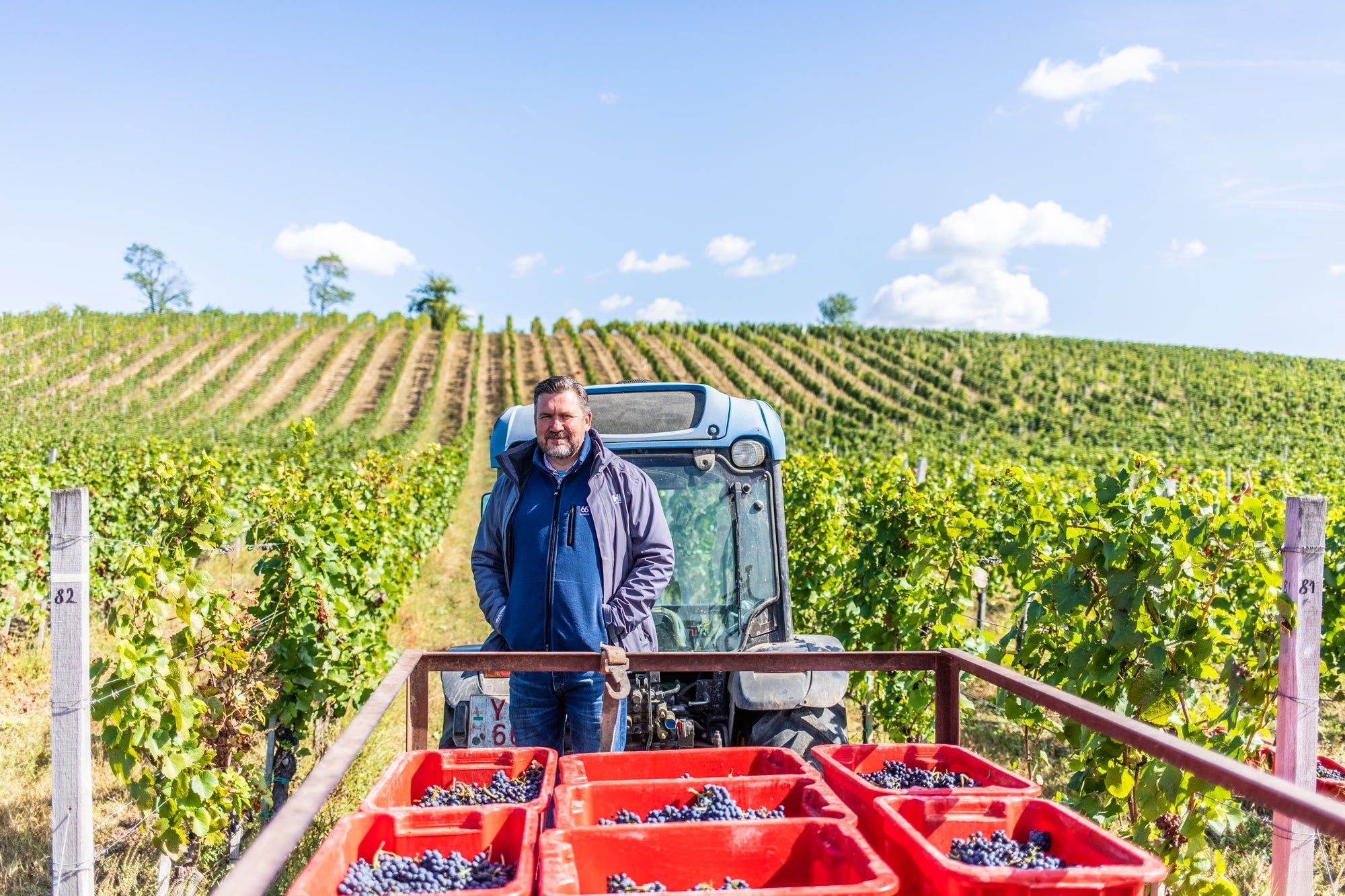
Sándor Mérész is the head winemaker at Etyeki Kúria. He comes from Gömör, where legend has it that King Matthias made the landlords hoe their fields. Before joining Etyeki Kúria, he worked in California (Kendall Jackson Vineyard Estates) and Tuscany (AIA Vecchia Bolgheri), and afterwards he came to the Kúria from the Debreczeni-Ferenczi estate in Etyek. A seeker of new paths, he has been developing the product range for ten years, harmonizing the experience based on the observations of the elders with the latest research results, paying attention to the balance between nature and technology in quality winemaking.
Earlier, we learned that his path first led from Gyöngyös College to the California Kendall Jackson Winery, then after returning home, following unsuccessful job hunting and before another trip to California, he got the opportunity at Tibor Gál’s winery, from where his career continued with a decision made in ten minutes at the Tuscan AIA Vecchia winery from 2001 to 2005.
– Adventurous spirit or the warmth of home?
Long silence. – Now the latter, I have settled down. He laughs.
– Zenit or Canon?
He laughs. – Provocative questions, now neither.
– Do you have a favorite female winemaker?
– I don’t like such distinctions, a winemaker is a winemaker!
– Do you consider yourself a good winemaker?
– Yes.
– Where do you see yourself in 10 years?
– We’ll see in 10 years.
– Is it true that you wanted to be a world-famous saxophonist and dreamed of jazz tours?
– That’s not exactly true, but when I was in college, I had a very good friend who played music, and he infected me. My daughters know I play, but they prefer guitar, and now I also play guitar.
– Is there a tech gadget that recently brought you joy?
– I’m not into gadgets. I prefer tangible, technical things.
– Will you have a winemaker successor in the family?
– I have two daughters, both skilled and sensitive to scents and flavors, but we don’t know yet if either will become a winemaker. My older daughter currently wants to be a marine biologist. There have been times when the blending couldn’t be done during the week, so I took the samples home. The 2018 rosé was made at home. I involved the kids; based on the scent, they chose which blend was the best. They can easily identify individual varieties—like a sauvignon—by their smell.
– Where did you work after Italy?
– After Italy, I worked for a while at G.I.A Winery in Eger. Then I joined Kálmán Debreczeni, who managed the Debreczeni Winery and the Ferenczi Vineyard, farming in Etyek and Szekszárd. Then in 2009, I was approached by Etyeki Kúria. The team then consisted of 4 people; two of us worked in the cellar, we started farming on 15 hectares, and then gradually expanded.

– Your team calls you Captain, where does this name come from?
– You have to earn it; they know I stand up for them and that I can do any of their jobs. They often ask me to show them a process or to step in for them, but they don’t abuse it!
What professional challenge occupies you most lately?
I want to clone people. One of the defining questions in the near future is what kind of team you can work with in the vineyard. The future of wineries may depend on this in the long term. It matters who handles the vines; seasonal workers can be found, but we have to train them if we don’t want to ruin the vineyard.
Even in higher education in Hungary, practical training is rare; at intermediate or lower levels, it is not solved at all. In the German or Austrian system, higher education builds on intermediate education; you have to complete a viticulture technical school or secondary school to study further in this field. Moreover, students have continuous opportunities to gain practical experience. It would be good if our professional training took this direction as well. It would also be useful if universities taught sociology and psychology to make it easier later to manage human relationships as a leader. Architecture is a similar category, to know what to pay attention to when creating a winery.
– What gives a wine its beauty?
– The terroir is very defining; it provides the framework, and you can’t really change it. After a few years, when you think you’ve figured it out a bit, you realize you haven’t. Every year is full of surprises; the path to the perfect wine is slow.
– How do you develop and learn?
– We work on the same area year after year; you have to get to know it and taste often: the work is about continuous fine-tuning, which means learning in our profession never ends. You can learn a lot from friends and partners working in winemaking, such as our sister winery, Esterházy Winery, or the consulting company led by Stéphane Derenoncourt.
You learn the most from your own mistakes. There hasn’t been a single identical vintage in ten years, and we prepare for that there won’t be one. This learning process is greatly helped by the fact that the two areas, Sopron and Etyek, run in parallel. Somehow, except for California, in my career so far I have had to supervise two areas simultaneously. It was like this at the Tuscan AIA Vecchia (Bolgheri and Maremma), at G.I.A Winery (Eger and Nagygombos), at Debreczeni Winery, at Ferenczi Vineyard (Etyek and Szekszárd), and here as well (Etyek and Sopron).
– How are you with memorizing flavors and mental pairings?
– Tibor Gál had very rare abilities in this regard; he was a great blender and blended excellently. He must have had a fantastic memory: there was the Eger cellar, the Nagygombos winery, he made Heimann, Pannonhalmi Winery also started, maybe he worked for Vylyan too, about 10-12 wineries, thousands of items were in his head. He imagined the pairings and juggled them mentally. He tasted a lot. He was much more recognized in Western Europe than at home; in Tuscany, he was considered an icon. He was a genius in his field; few winemaker professionals comparable to him are born.
– Is there an area where you would like to try yourself and gain more experience?
– If a winemaker is given the chance to work in a world-class area, 90-point wines come easily. I have already worked in such a place, and it’s a fantastic feeling when top wines come from top terroirs. A good winemaker tries to get the most out of every terroir; if you work in a weaker area, you have to add a lot. If you add a lot in top areas, iconic wines are born. I see many opportunities in Sopron, with good soils and vineyards. I also like working in Etyek; here we are already in the refinement phase, there was a good base, and we try to add to it.