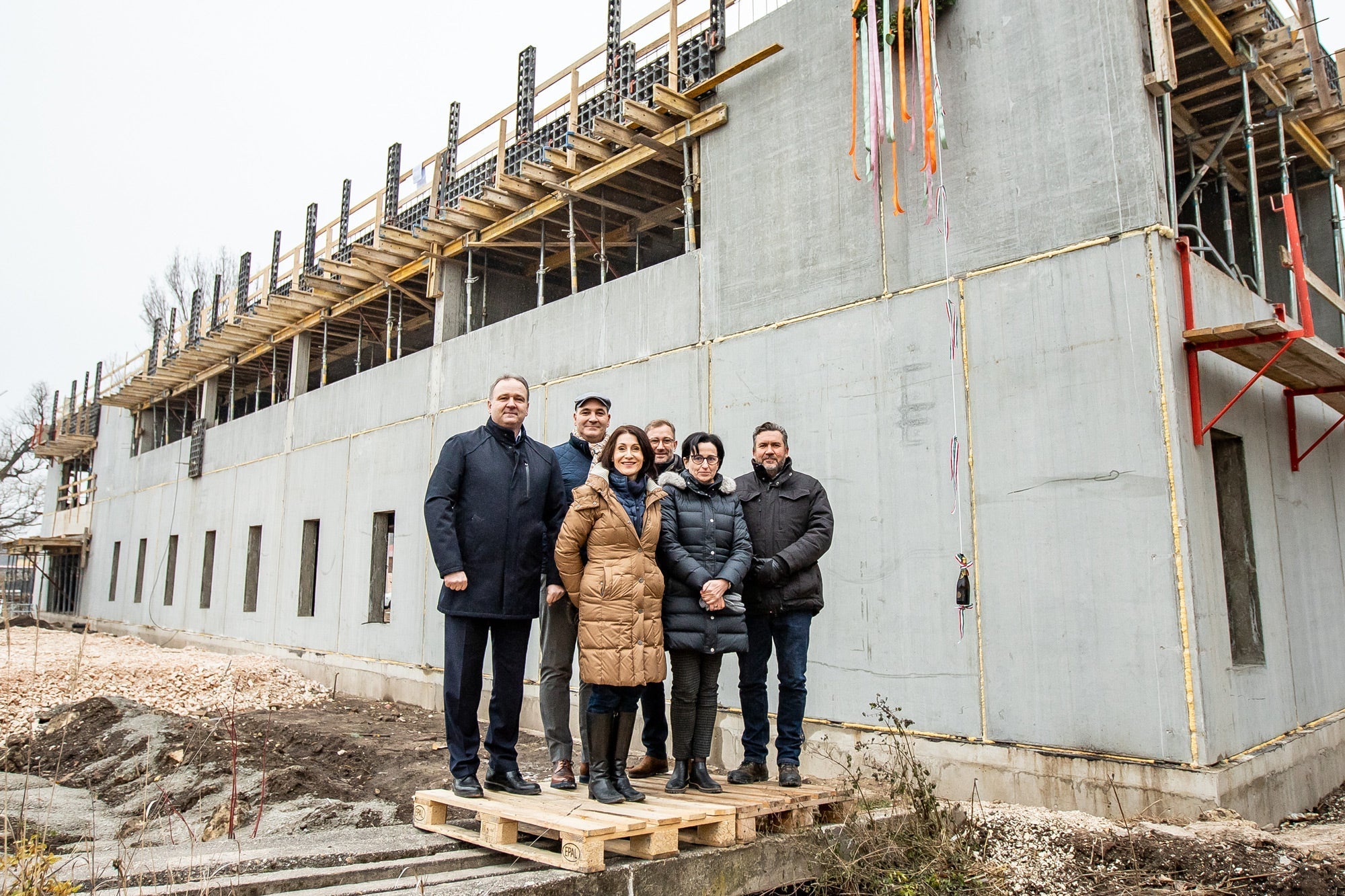
As a result of conscious professional work and strategic planning, we have been able to expand much faster than planned in recent years, so our winery outgrew its previous building by 2023. Our Etyek-Öreghegy cellar's production capacity has consistently been exceeded in recent years, which has posed numerous operational challenges for the winemaking team led by head winemaker Sándor Mérész.
In recent years, our well-coordinated management team, under the leadership of CEO László Babarczi, analyzed every aspect of our operations; we updated our strategic and long-term business plans. Based on this, we concluded that for further growth; to improve the quality of winemaking; and to enhance the safety of bottling and storage, we needed a new, uncompromising facility that meets all expectations. Planning began during the Covid pandemic lockdowns. We successfully applied for non-refundable funding to realize the investment, so by the end of August 2023, we were able to take possession of our new building, allowing the processing of grapes from the 2023 harvest to take place there. The primary goal of the investment was to optimize grape processing and improve winemaking conditions so that our growth would happen while maintaining—and even continuously improving—quality, while enabling the use of new winemaking technologies we had not previously employed.

Our new facility—located halfway between Etyek and Alcsútdoboz—already has more than double the capacity of the previous one at its launch. Additionally, thanks to logistical improvements, storage, transportation, and overall commerce have become much simpler, which significantly eases the work of our commercial manager Vince Nagy and his team in serving our customers and partners faster and more efficiently. But not only winemaking and storage moved to the new building; we also created more modern and comfortable working conditions in our new offices for our office staff, including the finance team led by Tünde Lehoczki. Even in our previous facility, numerous forward-thinking “green investments” helped us leave the smallest possible carbon footprint; naturally, we placed great emphasis on this again in the new building:
- The new winemaking facility is located significantly closer to our vineyards.
- Solar panels contribute to the building’s energy supply.
- Energy-efficient LED lighting is used everywhere, and energy efficiency was a key consideration in selecting the installed machines and equipment.
- The hall has advanced thermal insulation, and on part of the facade, we grow wild grapevines on a special structure to provide additional natural shading and thus increase energy efficiency.
- Technological water generated during winemaking is collected and purified separately, a solution that will be unique among wineries in Hungary.
The question arises: what happened to our previous building, located in Etyek in the most beautiful part of the historically significant Öreghegy? Well, the answer is obvious! On one hand, we age traditional (bottle-fermented) sparkling wine in larger quantities than before; on the other hand, under the direction of our wine tourism manager Szabolcs Szerepi, we are implementing tourism developments and expanding our hospitality and event offerings, allowing our guests to enjoy even more experiences with us.

Why did we need a new winemaking building?
Our head winemaker Sándor Mérész shares…
“In the winemaking business—let’s not kid ourselves—the winery ideally operates as a profit-generating facility. The owner had long thought on a larger scale and built the current management team accordingly. Due to vineyard expansion, space simply ran out in Etyek (at production sites), and further growth was impossible. This doesn’t mean there was suddenly no place to store bottled products, but rather that the building couldn’t keep up with the pace of development. Traffic increased, along with related logistical problems, the number of bottles, and naturally, revenue. In recent years, even daily work organization required extra effort. For example, unloading one pallet meant moving another thirty.
We first faced these issues at the outbreak of Covid, so planning and continuous updating of plans took 2-3 years. Our main goal was to improve revenue, but it would have been foolish to respond with price increases, which wouldn’t have worked anyway. We commissioned a study that clearly showed that vineyards with fewer than 5,000 vines per hectare are uneconomical, regardless of the condition of the grapes. Increasing revenue can also be achieved by cost reduction and efficiency improvements, so some plots had to be replanted. The logical continuation is that more grapes produce more wine, and these tanks and eventually bottles need to be stored somewhere.
At first, we considered expanding storage, then we saw bottling there as well, and finally decided to centralize production and move everything. Our sparkling wine cellar remains and expands at Öreghegy. Classic sparkling wine has become a prestige product in Etyek, and we aim to play a leading role in this as well.”
The new winemaking facility in numbers
“As I mentioned, a classic sparkling wine cellar was established at Öreghegy, while our new production building houses tank sparkling wines and sparkling wines as well. These also required space due to volume growth. We consider it important to do as much as possible ourselves during sparkling wine production. If the experience stays with us year after year, a learning process begins, and the company truly benefits. We had to see that a facility works properly if it operates at about 70% capacity, leaving enough room for unexpected situations. The new facility offers 2,500 m², easily expandable by another 500 m². Due to the industrial environment, it is easily developable; it is a lightweight structure made of sandwich panels. The whole thing is simple and great, with high ceilings that can accommodate taller tanks. I can’t stop admiring the finished goods warehouse shelving system; logistics is much smoother too.”

“Regarding plantings and replantings, we are expanding our portfolio. In Etyek, we are trying the now classic Pinot Noir in a cooler, east-facing location, and the ‘holy trinity’ (pinot noir, chardonnay, sauvignon blanc) will be expanded with further surprises. We are also developing our supplier base to ensure that purchases include the highest quality grapes possible.”
Closer to the vineyards
Where is the new winemaking building located?
Our CEO László Babarczi answers: “First of all, although we only call it ‘Göböl,’ it is actually Göböljárás and administratively belongs to Alcsútdoboz. This part of the settlement—which had several hundred residents in the 1940s—is located halfway between Etyek and Alcsútdoboz and has always functioned as an agricultural estate center. Its name refers to this, as ‘göböl’ originally means a fattening cattle; the animal raised for its meat. We understand that agricultural training was once conducted here, and there is a beautiful granary built in the 19th century, which has belonged to the Etyeki Kúria winery since its founding in 1996. In 2009, together with Sándor Mérész, we even proposed building a winery here on the plot of this building, but the owners ultimately decided on the Etyek Öreghegy location. That’s how our estate center was built, which won Hungary’s Most Beautiful Wine Estate award in 2022 and the Business Traveller Hungary - Business Excellence Best Rural Event Venue audience award in 2023. You could say no bad decision was made back then!
We thought for a long time about what function would be most worthy of the old, historic granary building and useful for us, but whatever we considered would have only been possible with many compromises. Nevertheless, this location has always been on our minds.

When we were working on our long-term strategic plan in 2020, by a banal coincidence, we learned that the empty plot opposite our granary building was for sale. We immediately knew this would be the perfect location for a new facility. Fortunately, we managed to buy the plot, and from then on, there was no stopping…”
Why was expansion important?
“As our head winemaker Sándor Mérész already said, the dynamic expansion at the Etyek Öreghegy winery, the many new products, significant wine tourism, and limited space meant that in recent years we had to make too many compromises. We definitely wanted to preserve the charm and atmosphere of the place, but we needed space to move forward and to realize our new winemaking ideas. Göböl was the perfect answer to these challenges: it is closer to our vineyards, so we use less fuel and our tractors wear less; here we can realize a greenfield investment opposite our beautiful old granary, meaning we can shape it exactly as we need, and from an energy-saving perspective, the building’s thermal insulation, numerous solar panels, charging stations for electric cars, and water recovery—where water can be used for irrigation—are all significant. In short, the new building is a logically planned greenfield investment that meets all the challenges of today’s times.
We have had a long-standing working relationship with the Studio Fragment design office. Imre Bődi, architect and co-owner, also participated in building our previous estate center. Together with his co-owner Zsolt Frikker, they have designed several of our buildings. We understand each other almost without words.
As for the contractor, Arrabona Konstrukt Kft. from Győr, led by managing owners Barnabás Gergye and Dávid Bognár, proved to be very flexible, knowledgeable, and conscientious. The ITAG Építő Kft. and architect-technical inspector Ákos Holy were extremely precise and competent partners, whose work made the architects’ vision of a human-scale new building that harmonizes architecturally with the old granary across the street a reality.
Much of Göböljárás belonged to a state farm after World War II, which was then broken up in the 1990s. This caused surprises during project preparation and construction: property boundaries, cables, or buildings were not always where they should have been according to maps, or suddenly appeared. But we managed to solve all these issues, as well as problems like the lack of a sewage system, wired internet, and telephone in Göböl. We could tell many stories about how we ultimately overcame these challenges…”